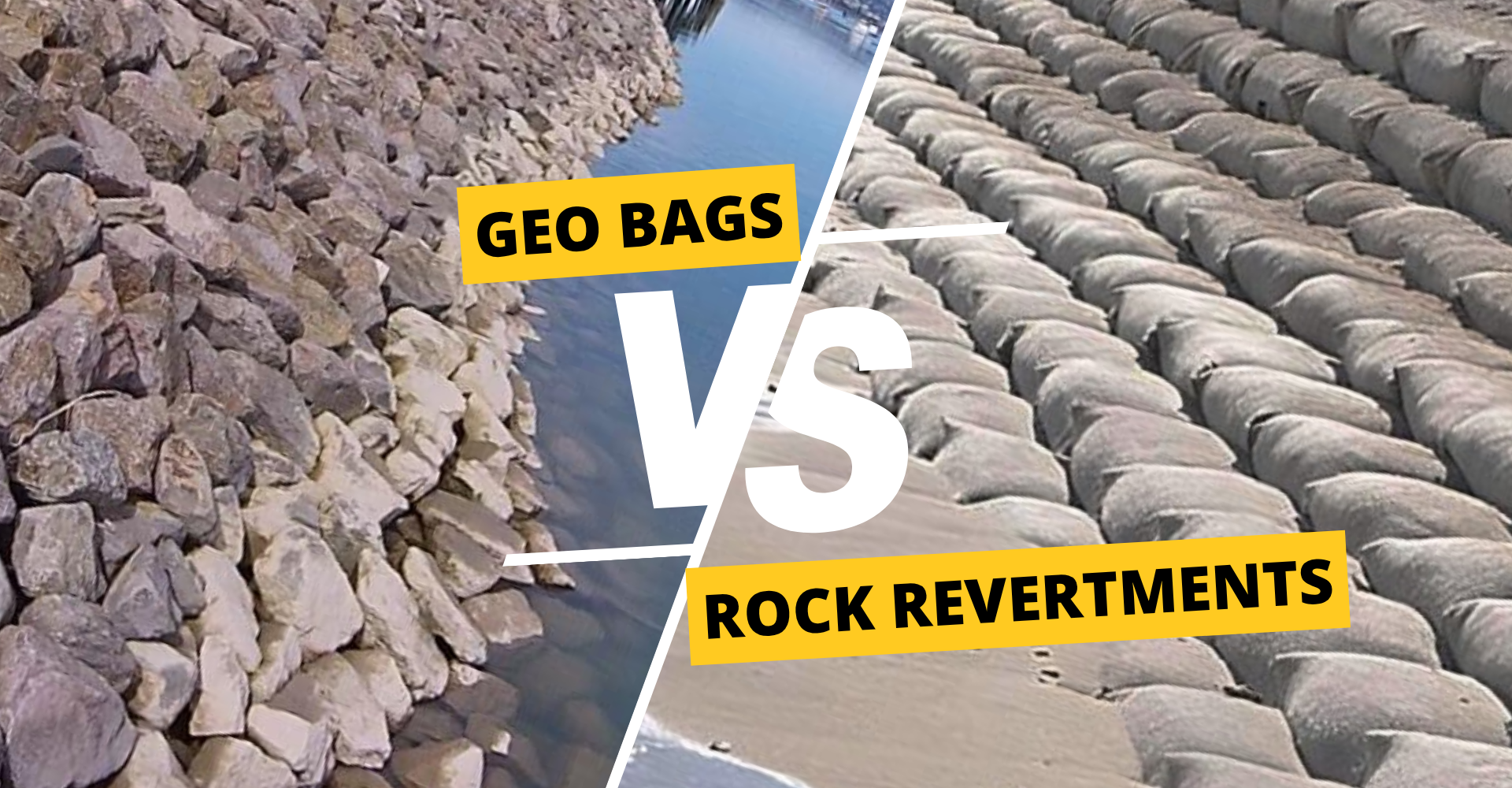
Geo Bags vs Rock Revetments: Which Coastal Protection Solution Is Better?
Coastal erosion remains one of the largest engineering challenges for ports, waterfront developments, beaches, industrial facilities, and marine infrastructure projects. Traditional hard-armour systems such as rock revetments have been widely used for decades, while geotextile sand container systems (Geotextile Bags) have increasingly become an alternative solution in coastal engineering.
For project owners and engineers, selecting between Geotextile Bags and rock revetments involves more than material preference. Hydraulic stability, wave energy dissipation, construction logistics, environmental impact, material availability, installation constraints, and project life-cycle cost all influence the final decision.
This article provides a technical comparison between Geotextile Bags and rock revetments based on engineering principles, research studies, and field applications.
What Are Geo Bags?
Geo Bags, also known as Geotextile Sand Containers (GSCs), are high-strength geotextile units filled with sand or locally available materials and arranged to form coastal protection structures.
Typical applications include:
Shoreline protection
Breakwaters
Dune reinforcement
Scour protection
Beach nourishment
Temporary coastal defenses
Artificial reefs
Marine construction works
Unlike conventional hard structures, Geo Bags are considered flexible systems that adapt to localized settlement and foundation variations.
What Are Rock Revetments?
Rock revetments are sloped armor layers consisting of natural quarry stones or concrete armor units placed on coastlines to absorb and dissipate wave energy.
Typical components include:
Armor layer
Filter layer
Underlayer
Bedding layer
Foundation preparation
Rock revetments have been widely implemented because of their long-term durability and well-established design methodologies.
Technical Comparison: Geo Bags vs Rock Revetments
| Parameter | Geo Bags | Rock Revetments |
|---|---|---|
| Structural flexibility | High | Moderate |
| Settlement tolerance | High | Low |
| Installation speed | Fast | Moderate |
| Material transportation | Lower | High |
| Environmental footprint | Lower | Higher |
| Hydraulic performance | Good | Excellent |
| Quarry material requirement | Minimal | High |
| Adaptability to soft foundations | High | Moderate |
| Maintenance requirement | Moderate | Low |
| Long-term durability | Moderate to High | High |
Hydraulic Performance and Wave Energy Dissipation
The primary function of both systems is to reduce wave energy before it reaches protected assets.
Rock revetments dissipate wave energy through voids between armor stones. The irregular surface geometry creates turbulence, reducing reflected wave forces.
Geotextile Sand Bag systems dissipate wave energy differently. Their deformable surfaces absorb part of the impact energy while reducing reflected waves.
Laboratory investigations on geotextile coastal structures found that properly designed Geotextile Sand Bag revetments can provide hydraulic performance comparable to traditional systems under specific wave conditions. Experimental studies evaluated reflection coefficients, transmission coefficients, and hydraulic stability under varying wave conditions.
However, hydraulic stability becomes increasingly important under extreme storm loading.
Design variables include:
Wave height
Wave period
Water depth
Fill ratio
Structure slope
Container dimensions
Geotextile properties
Real Project Examples
Stockton Beach, Australia
Stockton Beach used geotextile sand container revetments as emergency shoreline protection to protect infrastructure exposed to severe erosion.
The project demonstrated rapid deployment advantages and practical coastal protection capability under demanding environmental conditions.
Narrowneck Reef, Australia
The Narrowneck artificial reef project incorporated large geotextile containers for shoreline stabilization and beach enhancement.
The project became one of the most recognized examples of geotextile coastal structures used at large scale.
South African Coastal Defense Projects
Several coastal projects along South Africa’s eastern coastline adopted geotextile sand containers as alternatives to traditional hard structures.
Field observations identified key design factors influencing performance:
Fill ratio optimization
Internal sand movement
Seam strength
Material durability
Sand leakage prevention
Researchers concluded that installation quality significantly affects long-term performance.
Design Considerations for Engineers
When Geotextile Sand Bags May Be Preferred
Geo Bags may be suitable when:
Large armor rocks are unavailable
Quarry transportation costs are high
Rapid installation is required
Soft foundation soils exist
Environmental impacts must be minimized
Temporary or adaptive structures are needed
Examples include:
Temporary shoreline stabilization
Resort beaches
Marine construction projects
Emergency erosion control
When Rock Revetments May Be Preferred
Rock revetments may be preferred when:
Extreme wave loading exists
Long design life is required
Heavy storm exposure is expected
Maintenance access is limited
Permanent infrastructure protection is critical
Examples include:
Ports
Industrial waterfronts
Major seawalls
Harbor infrastructure
Cost Considerations
Project cost analysis should include more than initial construction cost.
Engineers typically evaluate:
Initial costs
Material cost
Transportation
Installation equipment
Labor
Life-cycle costs
Maintenance
Repair
Replacement
Monitoring
In regions where suitable rock quarries are distant, transportation can become a major cost factor. Geotextile Sand Bags frequently reduce logistics expenses because local sand materials can often be utilized.
Research also indicates that geotextile systems may reduce environmental disturbance associated with quarry extraction and transport activities.
Key Engineering Challenges for Geo Bags
Despite advantages, engineers must consider several limitations:
UV degradation
Extended ultraviolet exposure may reduce material performance if suitable protection measures are not used.
Abrasion damage
Continuous wave action and sediment movement can gradually wear external surfaces.
Seam failure
Improper stitching or manufacturing defects can reduce structural integrity.
Vandalism risk
Exposed geotextile systems may experience puncture damage.
Modern geotextile materials have significantly improved resistance to these mechanisms compared to earlier systems.
Which Coastal Protection Solution Is Better?
There is no universal answer.
Rock revetments generally remain the preferred choice for high-energy coastlines requiring very long service life and maximum structural robustness.
Geotextile Sand Bags provide strong advantages where flexibility, reduced environmental impact, faster installation, and lower logistics costs are important.
The best solution depends on site-specific engineering analysis including:
Hydraulic conditions
Geotechnical investigations
Material availability
Environmental constraints
Project life requirements
Budget considerations
Increasingly, engineers are also using hybrid systems that combine geotextile technologies with conventional rock protection methods.
References
- Hornsey W., et al. “Geotextile Sand Container Shoreline Protection Systems: Design and Application.” Geotextiles and Geomembranes, 2011.
- Corvaro S., et al. “Hydraulic Performance of Geotextile Sand Containers for Coastal Defenses.” Journal of Marine Science and Engineering, 2022.
- Elias T., Shirlal K.G. “Preliminary Investigation on Stability and Hydraulic Performance of Geotextile Sand Container Breakwaters.” Scientific Reports, 2022.
- Jackson N.L., et al. “Geotextile Sand Filled Containers as Coastal Defence: South African Experience.” Geotextiles and Geomembranes, 2012.
- Recio J., Oumeraci H. “Processes Affecting the Hydraulic Stability of Coastal Revetments Made of Geotextile Sand Containers.” Coastal Engineering, 2009.