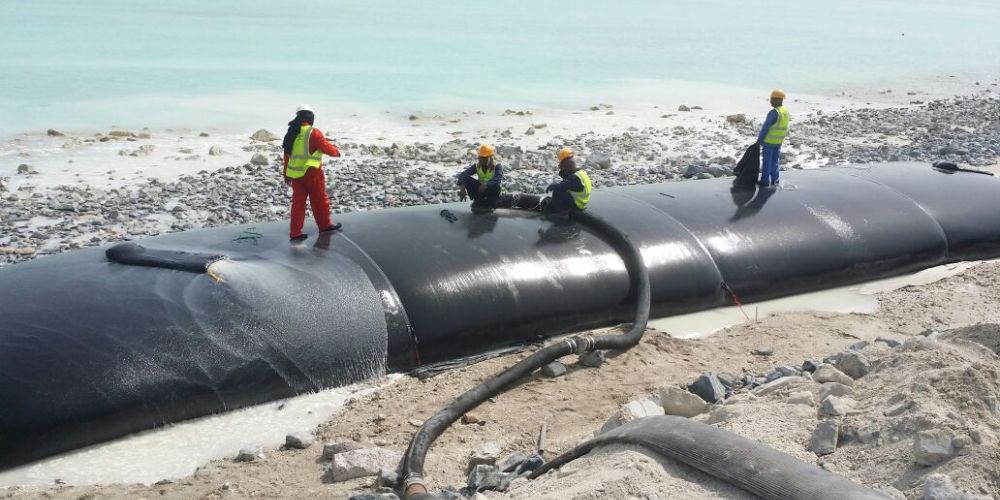
PET Woven Geo tubes for Coastal Protection, Dredging and Marine Engineering Applications
Introduction to PET Woven Geo tubes in Geotechnical Engineering
PET woven geo tubes (Polyester woven geotextile tubes) are high-strength tubular geosynthetic containment systems widely used in coastal protection, hydraulic engineering, dredging operations, and marine infrastructure projects. These systems are manufactured from high-tenacity polyester (PET) yarns woven into engineered geotextile fabrics designed for high tensile strength, controlled permeability, and long-term durability in aggressive marine environments.
Geotubes are hydraulically filled with dredged material, sand, or slurry. Water drains through the permeable woven fabric while solids are retained, allowing efficient dewatering and controlled consolidation of sediments. This mechanism makes them a practical alternative to traditional rock-based coastal structures in many engineering applications.
Engineering Behavior and Working Mechanism
The behavior of PET woven geotubes is governed by geotechnical and hydraulic principles.
Hydraulic Filling and Dewatering
During installation, slurry is pumped into the geotube. The woven fabric acts as a filter, allowing water to escape while retaining soil particles. This results in:
Rapid volume reduction
Controlled sediment dewatering
Improved consolidation
Reduced disposal volume
Tensile Membrane Action
Once filled, geotubes behave as tensioned membrane structures. Internal hydraulic pressure is resisted by the tensile strength of PET fibers.
Consolidation Behavior
After installation, the contained material consolidates under self-weight, increasing shear strength and improving long-term stability.
Geotextile tubes are widely used in shoreline protection, flood control, and dredged material containment applications due to this combined hydraulic–structural behavior.
Creep Resistance in PET Woven Geotubes (Critical Engineering Parameter)
One of the most important performance characteristics of PET geotubes is their low creep deformation under long-term loading.
What is Creep?
Creep is the time-dependent deformation of a material under constant stress. In coastal structures, geotubes are exposed to:
Constant hydrostatic pressure
Wave and current loading
Permanent fill weight
Foundation interaction stresses
Why Creep Matters in Geotubes
If creep is not controlled, structures may experience:
Gradual deformation
Loss of geometry
Reduced stability
Uneven settlement
Why PET Performs Better
Polyester (PET) has significantly better creep resistance compared to polypropylene due to:
High molecular chain stability
Low stress relaxation
Strong long-term tensile retention
Reduced viscoelastic deformation
This makes PET woven geotubes suitable for semi-permanent and permanent coastal engineering structures, including breakwaters and shoreline stabilization systems.
Material Characteristics of PET Woven Geotubes
High-Tenacity Polyester Reinforcement
High tensile strength
Low elongation under load
Long-term stability
Reduced creep deformation
Woven Geotextile Structure
Controlled permeability
Efficient filtration
Soil retention capability
Resistance to particle loss during filling
Environmental Resistance
UV resistance
Saltwater durability
Chemical resistance
Biological stability
Engineering Standards and Design Framework
PET woven geotubes are typically designed using internationally recognized geosynthetic standards:
ASTM D4595 – Tensile properties of geotextiles
ASTM D4491 – Water permeability of geotextiles
ASTM D4751 – Apparent opening size (AOS)
ASTM D5261 – Mass per unit area
ISO 10319 – Wide-width tensile strength testing
ISO 12956 – Filtration opening size evaluation
These standards ensure consistent mechanical and hydraulic performance across marine and geotechnical applications.
Applications in Coastal and Hydraulic Engineering
Coastal Protection Systems
Geotubes are widely used for shoreline stabilization and wave energy dissipation. They act as artificial breakwaters that reduce coastal erosion.
Dredged Material Management
They are commonly used for dewatering dredged sediments, reducing disposal volume and enabling controlled handling of marine soils.
River Training and Flood Control
Applications include:
Riverbank stabilization
Flood embankments
Flow channel control
Land Reclamation
Used as containment structures to support controlled filling and settlement behavior.
Marine Infrastructure Protection
Protection of:
Pipelines
Subsea cables
Offshore structures
Engineering Design Considerations
Hydraulic and Sediment Properties
Grain size distribution
Slurry density
Permeability behavior
Filling Method Control
Improper filling can cause:
Fabric overstressing
Uneven deformation
Structural instability
Site Conditions
Bearing capacity
Settlement behavior
Soil interaction
Environmental Loading
Wave forces
Current velocity
Tidal variation
Storm exposure
Long-Term Stability
Creep resistance and material durability are critical for permanent installations.
Advantages of PET Woven Geotubes
High structural strength
Excellent creep resistance
Cost-effective alternative to rock structures
Fast installation
Reduced environmental impact
Adaptability to complex coastal geometries
Long service life in marine conditions
Engineering Limitations
Requires controlled filling operations
Needs proper geotechnical design
Sensitive to installation quality
Performance depends on sediment type
Skytechen Geotechnical Engineering Solutions
Skytechen supplies high-performance PET woven geotubes engineered for coastal protection, dredging operations, river engineering, and marine infrastructure applications. Our systems are designed for high tensile performance, hydraulic efficiency, and long-term structural stability in demanding marine environments.
We provide project-specific engineering support including design consultation, material selection, and application optimization.
Contact Skytechen for technical assistance and customized geotube solutions.
References (Technical and Academic Sources)
- ASTM International Standards (Geotextile Testing Standards)
ASTM D4595 – Tensile Properties of Geotextiles
ASTM D4491 – Water Permeability of Geotextiles
ASTM D4751 – Apparent Opening Size (AOS)
ASTM D5261 – Mass per Unit Area of Geotextiles - ISO Geosynthetics Standards
ISO 10319 – Wide-Width Tensile Test for Geosynthetics
ISO 12956 – Determination of Characteristic Opening Size - Peer-Reviewed Research Articles
Lee, S.C. et al. (2014) – Utilization of Geotextile Tube for Coastal and Muddy Shore Management
Koerner, R.M. & Koerner, G.R. – Geotextile Tube Applications in Civil Engineering
Pilarczyk, K.W. – Geosynthetics in Hydraulic and Coastal Engineering - USACE (U.S. Army Corps of Engineers) Technical Publications
Geotextile Tubes in Dredging and Coastal Protection Applications
USACE Engineering Guidelines on Dredged Material Containment - Coastal Engineering Knowledge Base
Coastal Wiki – Sand-filled Geosystems in Coastal Engineering
Disclaimer
Design performance of PET woven geotubes depends on site-specific geotechnical conditions, hydraulic loading, and installation methodology. Final design should follow detailed engineering analysis in accordance with applicable ASTM/ISO standards and project specifications.