7 Critical Silt Curtain Regulations and Compliance Requirements for Marine Construction Projects
Understanding Silt Curtain Regulations in Marine Environmental Protection
Marine construction projects, dredging activities, shoreline developments, land reclamation works, offshore installations, and port expansion projects can generate significant amounts of suspended sediment within surrounding water bodies. If sediment movement is not properly controlled, increased turbidity may affect marine ecosystems, water quality, aquatic habitats, fisheries, and environmentally sensitive areas.
As environmental requirements become increasingly stringent across marine projects worldwide, sediment containment measures have become a fundamental component of project planning and environmental management programs. Silt curtains, also referred to as turbidity curtains or sediment barriers, are among the most commonly implemented systems used to minimize the migration of suspended particles during marine activities.
Beyond simple containment applications, modern silt curtain systems are now considered part of broader environmental protection strategies supporting regulatory compliance, sustainable construction practices, and operational risk management.
Why Silt Curtain Compliance Is Important
Marine environmental authorities and project owners commonly require sediment management measures as part of environmental approvals and operational permits.
Proper sediment containment supports:
Water quality management
Reduced environmental impact
Protection of aquatic ecosystems
Compliance with project permits
Reduction of environmental risk
Improved operational efficiency
Lower remediation costs
Failure to implement effective sediment control systems can potentially result in:
Project delays
Increased monitoring requirements
Corrective actions
Environmental penalties
Additional operational costs
For this reason, proper design and deployment of silt curtain systems has become an essential requirement for many marine infrastructure projects.
Understanding How Silt Curtains Function
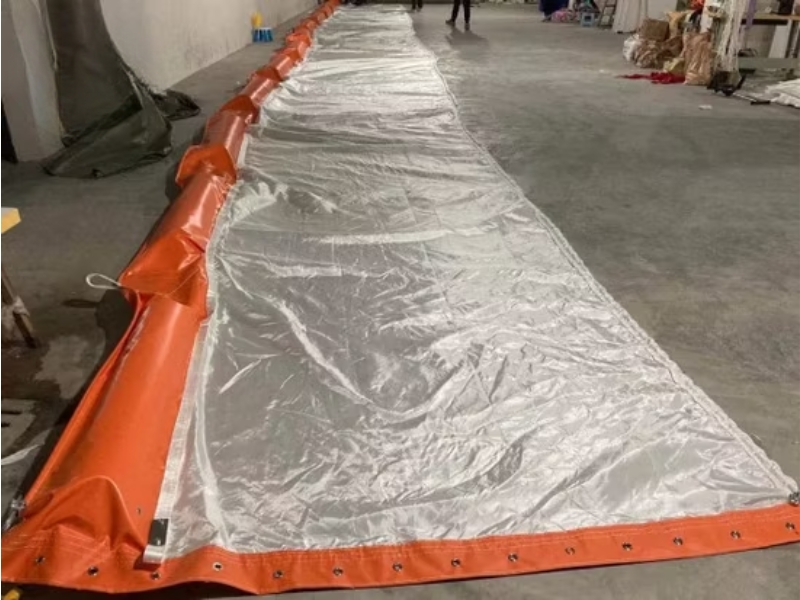
Silt curtains are floating containment systems designed to reduce the horizontal movement of suspended sediment particles within a water column.
Unlike oil containment booms that control floating hydrocarbons at the water surface, silt curtains create a hydraulic barrier that slows sediment migration and allows suspended particles to settle naturally through sedimentation processes.
A typical system includes:
Flotation System
Surface flotation maintains positive buoyancy and positions the curtain along the water surface.
Common flotation materials include:
Closed-cell foam
EPS flotation systems
Cylindrical flotation chambers
Marine-grade buoyancy systems
Reinforced Skirt Section
The suspended skirt forms the primary containment barrier extending below the water surface.
Common materials include:
Reinforced PVC
Composite marine fabrics
Polyester-reinforced membranes
Heavy-duty industrial fabrics
Ballast Chain Assembly
Ballast systems maintain curtain alignment and improve vertical stability under varying operational conditions.
Anchoring Systems
Anchors and mooring systems maintain positioning and reduce movement generated by waves and currents.
7 Critical Silt Curtain Regulations and Compliance Requirements
1. Water Turbidity Control Requirements
Environmental permits commonly establish acceptable turbidity thresholds outside active construction zones.
Monitoring programs may assess:
Total Suspended Solids (TSS)
Turbidity levels
Water clarity
Suspended sediment concentration
If measurements exceed approved limits, projects may require corrective actions including:
Additional containment measures
Revised construction methods
Additional monitoring
Expanded containment zones
2. Environmental Impact Assessment Requirements
Many large-scale marine developments require environmental impact assessments before project approval.
Typical assessments evaluate:
Marine habitat sensitivity
Water quality impact
Sediment transport behavior
Fisheries impact
Ecosystem effects
Coastal environmental conditions
Silt curtain systems are often identified as mitigation measures within environmental management documentation.
3. Sediment Control Management Plans
Project documentation frequently requires defined sediment management procedures.
Typical plans include:
Containment drawings
Deployment procedures
Inspection schedules
Monitoring requirements
Emergency response actions
Maintenance procedures
Well-documented procedures improve consistency and compliance performance.
4. Site Condition Limitations
Environmental conditions significantly influence silt curtain effectiveness.
Engineering evaluations commonly review:
Water Depth
Curtain depth directly affects sediment containment performance.
Current Velocity
Increased current speed can increase hydraulic loading and drag forces.
Wave Conditions
Wave energy affects structural stability and containment effectiveness.
Tidal Movement
Changing water levels may affect system geometry and anchoring performance.
Site-specific analysis improves system selection and deployment success.
5. Inspection and Maintenance Requirements
Routine inspection procedures improve operational performance.
Inspection activities commonly include:
Floatation inspection
Fabric integrity checks
Connector inspection
Anchor condition verification
Ballast system evaluation
Structural damage assessment
Regular maintenance helps reduce operational risk.
6. Protection of Sensitive Marine Environments
Additional environmental requirements are commonly implemented near:
Coral ecosystems
Mangrove habitats
Protected coastal areas
Fish breeding zones
Marine conservation regions
Projects in environmentally sensitive locations may require enhanced containment systems and increased monitoring frequency.
7. Contractor Environmental Responsibilities
Marine contractors frequently maintain direct responsibility for environmental performance.
Typical responsibilities include:
Correct deployment procedures
Maintaining containment effectiveness
Environmental monitoring support
Inspection reporting
Corrective action implementation
Operational documentation
Strong environmental management practices reduce risk while supporting project continuity.
Technical Considerations for Selecting Silt Curtains
Proper selection requires evaluation of multiple engineering variables.
Key considerations include:
Water Depth Analysis
Improper curtain depth can reduce containment performance.
Hydrodynamic Conditions
Wave action and current velocity directly affect loading conditions.
Sediment Characteristics
Different sediment particles exhibit varying settlement behaviors.
Examples include:
Fine clay particles
Silts
Sand particles
Organic materials
Project Duration
Temporary installations and long-term projects may require different material specifications.
Deployment Environment
Environmental conditions determine appropriate curtain classifications and anchoring requirements.
Best Practices for Effective Silt Curtain Performance
To maximize operational effectiveness, project teams commonly follow several best practices:
Select appropriate curtain classifications
Conduct site-specific engineering assessments
Monitor water quality regularly
Perform routine inspections
Verify anchor performance
Train installation personnel
Establish maintenance procedures
Combining engineering analysis with operational controls improves containment efficiency and environmental protection.
Skytech Marine Environmental Solutions
Skytech provides advanced silt curtain systems engineered for demanding marine and industrial environments. Our solutions are designed to support sediment containment requirements for dredging projects, coastal developments, offshore works, port construction, and environmental protection initiatives.
Through high-performance materials, reliable deployment systems, and application-specific engineering support, Skytechen helps organizations improve environmental management and operational efficiency.
Contact Skytech today to learn more about our marine sediment control and environmental protection solutions.
References and Technical Sources
- US EPA – Sediments and Water Quality Guidance
Provides guidance on suspended sediments, total suspended solids (TSS), sedimentation rates, and water quality assessment methods relevant to marine sediment control. - US EPA – Turbidity Monitoring and Assessment Guidance
Reference for turbidity measurement concepts and environmental impacts associated with suspended particles in aquatic systems. - U.S. Geological Survey – Turbidity Science Topic
Provides technical information regarding turbidity measurement methods and suspended particle analysis. - NOAA – Turbidity and Sediment Information Resources
Reference explaining sediment movement, turbidity effects, and impacts on marine environments. - U.S. Army Corps of Engineers – Silt Curtains as a Dredging Project Management Practice
Describes silt curtains as a recognized Best Management Practice (BMP) used for controlling suspended sediment in marine and dredging operations. - U.S. Army Corps of Engineers – Functional Capabilities and Performance of Silt Curtains
Technical study discussing deployment conditions, hydraulic performance, and effectiveness of silt curtain systems. - Massachusetts Erosion and Sediment Control Guidelines – Silt Curtain Guidance
Provides planning, installation, maintenance, and operational considerations for silt curtain systems.
Disclaimer
Regulatory requirements, environmental permit conditions, and marine construction guidelines may vary depending on project location and governing authorities. Site-specific engineering assessments should be performed before selecting and deploying silt curtain systems.